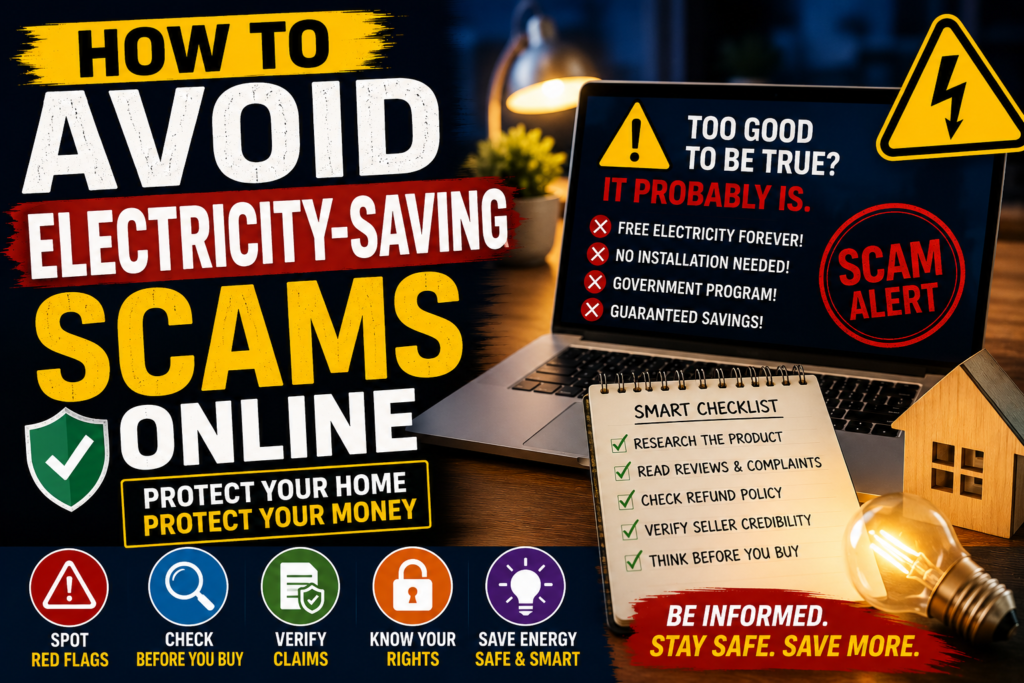
As electricity prices rise, more people search online for ways to reduce utility bills. Unfortunately, this creates an opportunity for misleading offers, exaggerated claims, and electricity-saving scams.
Some products are legitimate educational resources. Others may promise unrealistic results, such as free electricity, instant savings, or secret devices that eliminate bills without effort.
Before buying any energy-saving product, it is important to know the warning signs.
Red Flag 1: Guaranteed Free Electricity
Be careful with any product that promises to eliminate your electricity bill completely. Real energy savings depend on your home, climate, electricity usage, local rates, and equipment.
Even solar panels do not guarantee zero bills for every homeowner. The FTC warns that claims of free rooftop solar panels or never paying another electricity bill are often signs of a scam.
Red Flag 2: Fake Government or Utility Claims
Some scammers pretend to represent the government or your utility company. They may say you qualify for a special program or urgent discount.
The FTC says some clean energy scams involve people claiming to be with the government or a utility company while promising big savings on utility bills.
Always verify offers directly with your utility company or official government websites.
Red Flag 3: No Clear Product Explanation
Before buying, ask a simple question: what exactly am I receiving?
Is it:
- A PDF guide?
- A video course?
- A physical device?
- A solar panel system?
- A consultation?
- A subscription?
If the sales page is unclear, be careful. Honest sellers explain what the product includes and what it does not include.
Red Flag 4: No Safety Information
Any product involving electricity should explain safety clearly. If a guide suggests building or connecting devices without warning about risks, permits, or professional help, that is a serious concern.
Electrical work can be dangerous. Home wiring, batteries, inverters, and generators should be handled carefully.
Red Flag 5: Pressure Tactics
Be cautious when a page says you must buy immediately or the offer will disappear forever. Scarcity tactics are common in online marketing.
Take your time. Read reviews. Compare alternatives. Check refund policies.
Red Flag 6: No Refund Information
Before purchasing any digital guide, check whether the seller offers a refund. If the product is sold through a marketplace, read that platform’s refund terms.
A refund policy does not automatically prove that a product is good, but it gives buyers more protection if expectations are not met.
How to Research an Energy-Saving Product
Before buying, do this:
- Search for product reviews
- Search for complaints
- Check whether it is digital or physical
- Look for real screenshots or product details
- Check the refund policy
- Read the disclaimer
- Avoid exaggerated promises
- Compare with trusted energy-saving advice
We created this Energy Revolution System official review to help readers understand one popular ClickBank energy guide before visiting the sales page.
Safer Ways to Reduce Electricity Costs
Instead of relying only on online offers, start with proven methods:
- Use LED lighting
- Seal air leaks
- Maintain heating and cooling systems
- Use efficient appliances
- Reduce standby power
- Install a smart thermostat if suitable
- Compare utility energy-saving programs
- Consider a professional energy audit
ENERGY STAR explains that certified energy-efficient products meet strict specifications set by the U.S. EPA and can help save energy and money.
Final Thoughts
Electricity-saving scams often succeed because they target real problems: high bills, financial pressure, and the desire for energy independence.
The best protection is realistic thinking. If a product promises huge savings with no effort, no risk, and no clear explanation, be careful.
Legitimate energy savings usually come from practical steps, verified products, safe installation, and informed decisions.
Related Energy-Saving Articles
- Learn practical methods in our guide on how to reduce your electric bill at home .
- Discover simple energy-saving tips for homeowners that can help reduce monthly utility costs.
- New to alternative energy? Read our beginner guide to DIY home energy systems before starting.
- Compare solar panels vs DIY energy guides to understand which option may fit your home better.
- Protect yourself by learning how to avoid electricity-saving scams online .